
Infrastructure projects are becoming increasingly complex. More data, more stakeholders, more regulations... and, as a result, more delays. While project initiators want to move forward, permitting files often remain stalled for months or even years. That’s why Antea Group and SOLV have joined forces to untangle this challenge. Their shared mission? Using AI as a process partner to accelerate permitting procedures, strengthen stakeholder management, and make decision-making more transparent.
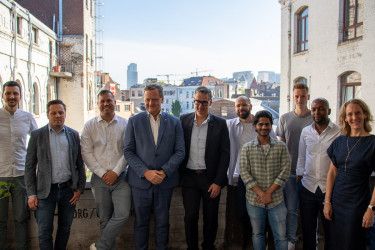
In conversation with: Marten Dugernier (Antea Group) and Roeline Ham (SOLV)

What was the main motivation behind entering into this partnership?

Marten: “Today, we see a major challenge in complex permitting processes that continue to consume more time and energy. Stakeholder participation typically leads to new insights, scenarios, and alternatives. As a result, the volume of information grows tremendously, both during the design phase and throughout the permitting procedures that follow. Without thoughtful stakeholder management, this generally leads to slower decision-making. That’s what we wanted to change.

With SOLV, we found a partner that not only provides technology but also offers a process-driven approach that truly works. Their AI platform helps us organize information more quickly, detect tensions at an early stage, and clearly map stakeholder interests. This allows us to deliver projects not only faster, but also with broader support.”

Roeline: “Antea Group operates in domains where the stakes are high: environment, water, mobility, infrastructure, and spatial planning. These projects generate enormous amounts of information and bring together a wide range of interests. That’s exactly the environment where SOLV makes a difference. Antea Group brings the domain expertise, while SOLV enables their teams to gain insights faster and anticipate challenges more effectively. The result is advice that is more consistent, faster, and stronger in content."

We use AI solely to extract information. All reasoning is performed through mathematical models, ensuring that our outputs remain traceable and defensible. It’s not a black box, but transparent logic.


Roeline Ham
COO (SOLV)
What technology powers the AI platform?

Roeline: “SOLV is not a generic AI that simply summarizes text. Our platform reads large volumes of documents, expert opinions, stakeholder input, and online signals, translating them into a structured model of stakeholders, risks, and scenarios. What’s crucial is that we only use AI to extract information. All reasoning is carried out through mathematical models, making our outputs traceable and defensible. No black box, just transparent logic.

We also develop custom solutions for Antea Group. One example is a module that automatically categorizes thousands of objections by theme, identifies pain points, and proposes solutions. This illustrates our approach: SOLV enhances existing ways of working without disrupting processes.”

How is AI changing the way permitting processes and stakeholder management are handled in practice?

Marten: “AI makes a difference on three fronts. First and foremost: speed. What used to take weeks can now be done in hours. The platform gathers and analyzes all relevant information and presents a complete picture. Second, AI creates focus. It links issues to stakeholders, visualizes points of friction, and clearly identifies where the real bottlenecks are. And finally, quality. Thanks to multi-criteria analyses, we can evaluate hundreds of scenarios based on effectiveness, efficiency, and stakeholder support. This results in shorter lead times and more efficient meetings and workshops.”

What is slowing down infrastructure projects today?

Roeline: “Projects are delayed because information accumulates faster than teams can process it. Policy documents, studies, stakeholder input, media streams... it grows every year. This leads to additional consultation rounds and late-stage surprises. SOLV removes that pressure by automatically reading and connecting the entire flow of information. The system identifies potential tensions early on. This enables Antea Group’s teams to provide advice more quickly and spend more time on substantive decisions.”

Instead of losing time to data, our experts gain the freedom to focus on what truly matters: creativity, vision, and collaboration.


Marten Dugernier
Lead Sales Urban Planning & Mobility (Antea Group)

How do you see the role of human expertise evolving as AI delivers more insights?

Marten: “We do not see artificial intelligence as a replacement for our people. One difficult reality is that our industry is facing a war for talent, and technical professionals are simply scarce. That means our experts’ time must be used as effectively as possible. In that regard, AI takes over repetitive work: reading, organizing, and connecting information. But assigning meaning, adding nuance, and making decisions remain fundamentally human responsibilities. Experts are therefore shifting from repetitive tasks to strategic roles. They evaluate design choices, engage in dialogue with stakeholders, and make decisions that require context and judgment. Instead of losing time to data, they gain the freedom to focus on what truly matters: creativity, vision, and collaboration.”

How do you see the role of AI evolving within infrastructure projects over the next five years?

Marten: “I believe AI will take on a very different role. Today, we mainly see it as a useful tool for processing information faster and evaluating scenarios. But within five years, AI will become much more than that. It will act as a process partner that continuously monitors and contributes. Imagine a system that picks up real-time signals from sources such as social media and immediately indicates where adjustments are needed. No more surprises at the end of a project, but proactive solutions along the way.”

What does this collaboration mean for the broader industry? Is this a blueprint for how infrastructure projects in Flanders and beyond will be approached?

Marten: "Absolutely. This is not an experiment, it’s a blueprint for agile decision-making. We’re not starting with an IT revolution, but with project-focused integrations that deliver immediate value. We combine AI with human expertise so that speed never comes at the expense of legitimacy. As an industry, we want to move forward, and this partnership demonstrates how that can be done: faster, smarter, and with broader stakeholder support. Flanders is taking a step that will also inspire adoption internationally."

Roeline: “This collaboration demonstrates how the engineering and consulting sector is evolving: not toward AI that summarizes text, but toward intelligence that evaluates cases, models risks, and makes insights traceable.

Expertise remains central, but it is no longer constrained by human processing capacity. Advisors can review hundreds of pages of complex input as if it were a single coherent picture. Stakeholder dynamics are no longer assessed intuitively, but modeled systematically. Antea Group is among the first consulting firms to actively embrace this transition.”