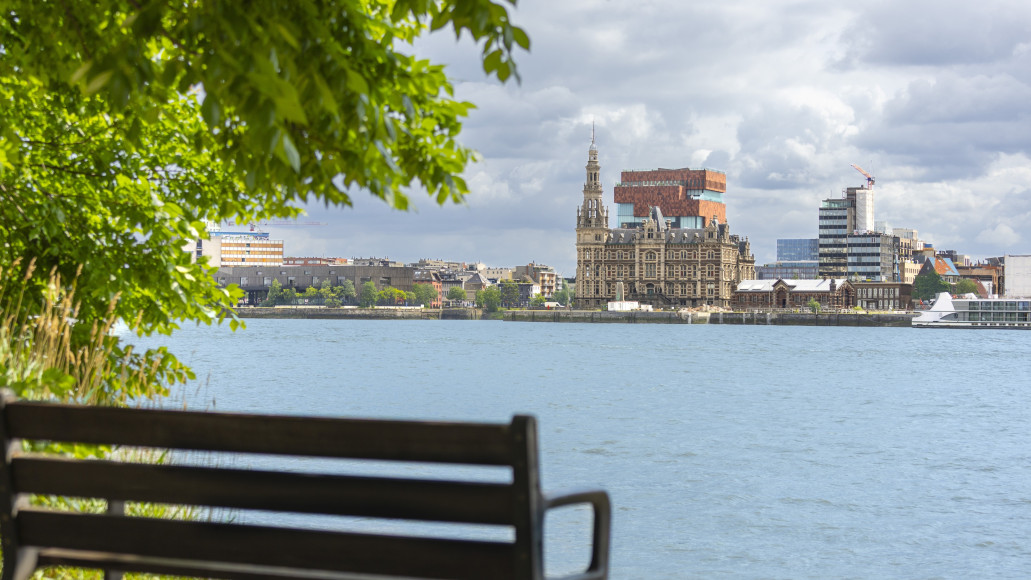
Climate change is causing increasingly frequent and intense heatwaves across Europe. This not only affects weather patterns, but also the temperature of surface water. For companies whose operations depend heavily on surface water, this creates new risks. This applies both to sectors that rely on water for cooling and heating - such as energy, industry, data centers, and aquathermal systems - and to companies that discharge water and must account for the temperature of the receiving surface water. Within Aquatemp, a European project under the Destination Earth initiative, Antea Group is contributing to a solution that translates climate data into concrete, actionable insights for the future.
Climate extremes as an underestimated risk for water-dependent industry
Many industrial processes and installations that use water are designed based on average water temperatures, often derived from historical data. This worked as long as the climate remained relatively stable, but climate change is making these references increasingly unreliable. Temperature extremes are becoming more frequent, heatwaves last longer, and combinations of heat and low river flows are occurring more often. This can lead to:
- Reduced efficiency in cooling systems
- Production limitations or temporary shutdowns during heatwaves
- Stricter regulations on thermal discharges
- Uncertainty in investment and permitting decisions
A critical missing piece today is detailed, location-specific insight into how surface water temperatures may evolve in the future and, most importantly, what this means under extreme conditions.
Aquatemp: from climate data to actionable insights
Aquatemp is a European project within the European Commission’s Destination Earth initiative, which develops digital twins of the Earth, highly detailed digital models that simulate climate scenarios and their impacts using machine learning.
Within Aquatemp, Antea Group collaborates with project partners Prophesea and RWI to convert powerful climate datasets into something tangible: future water temperatures in rivers and canals relevant to industrial applications. At its core is a demonstrator that:
- Combines high-resolution climate data from the Destination Earth climate change adaptation digital twin
- Uses state-of-the-art machine learning to translate this data into local water temperature predictions
- Produces actionable insights based on realistic storylines and scenarios tailored to different stakeholder groups
The scenario-based approach is essential. Rather than relying on a single “average” future, Aquatemp enables targeted questions such as:
- What happens to water temperatures during consecutive heatwaves?
- How quickly does a river warm up during drought conditions with low flow rates?
- How do critical temperature thresholds shift under different climate scenarios?
The models are trained on decades of climate and river data and provide probabilistic results: not fixed predictions, but ranges and likelihoods. This nuance is crucial for decision-making around temperature limits and risk management.
Antea Group plays a key role in identifying which scenarios are most relevant to stakeholders - ranging from industrial companies to water authorities - allowing users to explore multiple plausible futures, including their inherent uncertainties.
Tested on the Scheldt, scalable across Europe
The demonstrator is currently being developed for the Scheldt basin, a region where industry, energy production, and ecology are closely interconnected. However, the ambition goes further: integration into the DestinE platform and expansion to other European river basins.
Initial results highlight the urgency. Under certain climate scenarios, the number of days with increased thermal stress could rise by more than 30% compared to historical averages. Insights like these make it possible to assess today whether existing infrastructure is future-proof.
From climate data to real-world application
Aquatemp is a collaboration between:
- PropheSea: project coordination, machine learning, software, and user interface
- KMI/RMI (Royal Meteorological Institute of Belgium): climate and meteorological expertise, scenario development, and scientific quality assurance
- Antea Group: stakeholder engagement, use cases, translation of climate insights into relevant policy insights, and validation with end users
- Stakeholders including Evonik, Luminus, Extraqt, and De Vlaamse Waterweg, who actively contribute to the development process
Want to help build a climate-resilient industry?
Climate change cannot be planned away. But with the right data, scenarios, and collaboration, we can anticipate what lies ahead and be better prepared. That is why we actively invite companies and organizations that depend on cooling and process water to contribute ideas on use cases and applications. By co-developing these, we ensure the insights align as closely as possible with real-world needs.
Would you like to follow the research closely or actively contribute? Please contact Isabelle Herteleer, Senior Advisor Water, she will be happy to assist you.
For more information
Want to know more about this research?
We are happy to help!