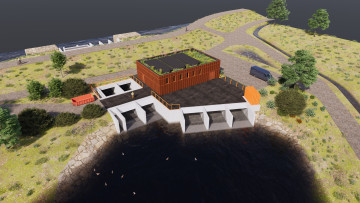
How do you design sustainable, climate-resilient water infrastructure that can withstand increasingly extreme weather conditions? That challenge was at the heart of the design for the new gravity drainage structure and Kalkenvaart pumping station in Wichelen. Working alongside OSQB and commissioned by the Flanders Environment Agency (VMM), Department of Watercourse Management and Investments, our experts developed a future-proof solution that reduces energy consumption while creating more space for biodiversity.
Less pumping, more natural drainage
The existing pumping station dates back to the 1970s. While it has served its purpose well for decades, today’s challenges call for a different approach. Longer periods of drought, followed by more intense rainfall events, combined with a growing focus on the surrounding environment, require a more flexible and sustainable system.
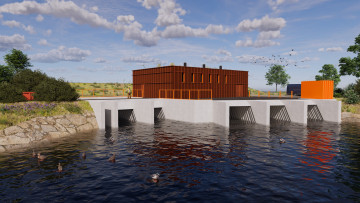
That is why the project involved not only the design of a new pumping station, but also a completely redesigned gravity drainage structure. This allows water to be discharged naturally and at a controlled rate toward the Scheldt River whenever conditions permit. Only when necessary do the pumps take over.
The new drainage structure significantly expands operational possibilities, enabling the system to function efficiently under a much wider range of conditions. The result is clear: lower energy consumption and a robust solution prepared for the challenges of the future.
Water management with biodiversity in mind
One of the most remarkable aspects of the design is how seamlessly flood protection and nature conservation go hand in hand. The new drainage structure includes not only two drainage channels, but also a dedicated fish passage channel. This improves fish migration opportunities and strengthens the ecological connection with the Scheldt River. In addition, a separate eel passage will be provided.
A deepened refuge pond further supports aquatic life during dry periods. Screens at the pump channels prevent larger fish from entering, while the pumps themselves are designed to be safe for both fish and eels.
Safety measures have also been intelligently integrated into the design. Multiple check valves, inspection chambers, and isolation facilities ensure that the system continues to operate safely and reliably, even during extreme weather events.
A compact pumping station with a big impact
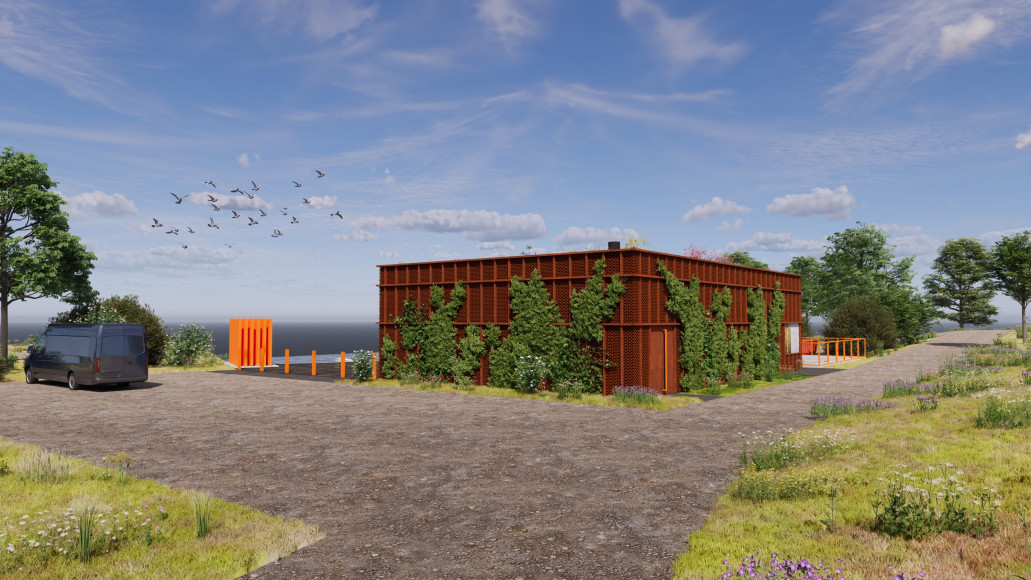
Careful integration into the landscape was a key design objective. Thanks to a series of thoughtful design choices, the visual impact of the pumping station remains limited. A low-profile building was deliberately chosen to remain below the dike’s sightline, preventing it from dominating the landscape. A green roof helps the structure blend into its surroundings, while a planted façade with climbing vegetation softens its technical appearance.
The building will not be connected to the public drinking water network. Instead, it will make use of harvested rainwater. Excess rainwater is directed to a swale, where it can infiltrate locally and recharge the groundwater system.
The pumping station also contributes to biodiversity. The green roof and climbing plants create additional habitat for insects and birds, while the vegetation helps absorb CO₂, produce oxygen, and filter fine particulate matter from the air.
Stronger through close collaboration
Projects such as Kalkenvaart demonstrate that modern water management is about far more than engineering alone. Through an integrated approach, hydraulics, ecology, architecture, and landscape quality were brought together in a single design. Thanks to the close collaboration between Antea Group and OSQB, these different ambitions were successfully combined into a future-oriented solution.
Want to know more about this project?
I am happy to help!